

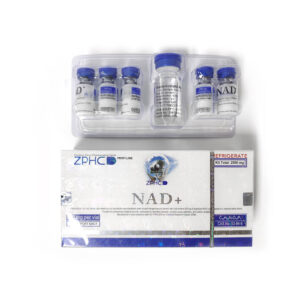
NAD+ ZPHC — 2500 mg KIT (5 Vials × 500 mg)
Product Overview
NAD+ ZPHC — 2500 mg KIT is a product presented as containing 2,500 mg of NAD+ across five 500 mg vials. NAD+, or nicotinamide adenine dinucleotide, is a naturally occurring coenzyme found throughout the body and is involved in fundamental cellular processes, including energy metabolism and oxidation-reduction reactions.
For consumers researching NAD+ products in the United States, understanding the product format, stated quantity, labeling, storage requirements, and intended use is essential. The ZPHC 2500 mg kit is packaged as five individual 500 mg vials, providing a clearly defined total quantity for those evaluating NAD+ formulations.
Because injectable products can involve meaningful safety considerations, buyers should verify the product’s labeling, regulatory status, manufacturing information, sterility documentation, and intended route of administration before use. A licensed healthcare professional can also provide guidance about whether an NAD+ product is appropriate for an individual’s circumstances.
What Is NAD+?
NAD+ (nicotinamide adenine dinucleotide) is a coenzyme involved in numerous biochemical reactions. It plays an important role in cellular metabolism by participating in reactions that help cells process nutrients and generate usable energy.
NAD+ exists naturally in the body and is related to the metabolism of carbohydrates, fats, and other nutrients. It also participates in cellular redox reactions, where NAD+ and its reduced form, NADH, help transfer electrons during metabolic processes.
Interest in NAD+ has increased substantially as researchers continue investigating its relationship with cellular metabolism, aging-related processes, mitochondrial function, and other biological pathways. However, research interest should not be confused with established clinical benefits for every proposed use.
ZPHC 2500 mg Kit Format
The NAD+ ZPHC 2500 mg KIT is identified by the following stated configuration:
- Product: NAD+ ZPHC
- Total stated quantity: 2,500 mg
- Number of vials: 5
- Amount per vial: 500 mg
- Total: 5 × 500 mg = 2,500 mg
- Active ingredient: NAD+ as represented on the product labeling
This five-vial configuration can make the total stated quantity straightforward to understand. Nevertheless, consumers should examine the actual packaging and accompanying documentation rather than relying solely on an online product description.
Why Product Verification Matters
When researching NAD+ products, product quality and authenticity deserve careful attention. Injectable preparations require substantially greater consideration than ordinary consumer products because contamination, incorrect concentration, improper storage, or compromised sterility can create serious risks.
A responsible evaluation should include checking whether the packaging identifies the manufacturer, lot or batch information, expiration information, ingredient details, storage requirements, and other relevant labeling.
Where available, independent laboratory documentation may also help consumers understand whether a product’s stated identity and concentration have been tested. Laboratory documentation should be evaluated carefully because the presence of a certificate or test report does not automatically establish that a product is approved for human use.
NAD+ and Cellular Energy
One reason NAD+ attracts scientific interest is its central role in cellular energy metabolism. NAD+ participates in biochemical pathways that help convert nutrients into energy.
Within these pathways, NAD+ can accept electrons and become NADH. NADH can subsequently participate in processes associated with cellular energy production. This continual conversion between NAD+ and NADH is an important component of normal cellular metabolism.
These biological functions help explain why NAD+ is frequently discussed in research concerning metabolism and mitochondrial biology. They do not, by themselves, establish that taking supplemental or injectable NAD+ will produce a particular health outcome.
Research Interest in NAD+
NAD+ and related metabolic pathways have been investigated across a broad range of scientific fields. Researchers have explored NAD+ biology in connection with cellular aging, mitochondrial processes, metabolic regulation, DNA repair mechanisms, and other areas of biomedical research.
Some NAD+-related compounds and precursors have received considerable attention in scientific literature. However, different compounds can have substantially different pharmacological and biological characteristics.
For that reason, consumers should distinguish between NAD+ itself, NAD+ precursors, and other compounds that influence NAD+ metabolism. Evidence concerning one substance should not automatically be interpreted as evidence supporting another.
Important Considerations for Injectable Products
An injectable NAD+ product should be evaluated differently from a standard dietary supplement. Sterility, preparation, administration technique, storage, and handling can all affect safety.
Potential concerns associated with improperly prepared or improperly handled injectable products can include contamination, infection, incorrect dosing, adverse reactions, and other complications.
Consumers should therefore avoid assuming that a product is suitable for injection simply because its packaging or marketing uses injectable terminology. The product’s actual labeling, regulatory status, manufacturing standards, and professional guidance should be considered.
Anyone considering an injectable NAD+ product should discuss the decision with an appropriately licensed healthcare professional.
Understanding the 2500 mg Total
The 2,500 mg total in this product configuration represents the stated combined amount across five 500 mg vials.
The arithmetic is straightforward:
5 vials × 500 mg per vial = 2,500 mg total
This total should not automatically be interpreted as a recommended amount to use. A product’s total package quantity is different from an individualized dose, treatment schedule, or medically appropriate amount.
Any administration instructions should come from appropriate professional guidance and the product’s verified labeling rather than from generalized internet recommendations.
Storage and Handling
Proper storage can be important for products containing biologically active compounds, particularly products intended for preparation or administration by injection.
The manufacturer’s verified storage instructions should be followed whenever available. Consumers should pay attention to temperature requirements, light exposure, expiration dates, packaging integrity, and other handling instructions.
A vial with damaged packaging, questionable labeling, an unclear expiration date, or evidence of contamination should not be used without appropriate professional evaluation.
Choosing a NAD+ Product Responsibly
People searching online for NAD+ 2500 mg, NAD+ 500 mg vials, NAD+ kits, or ZPHC NAD+ may encounter products with different formulations, concentrations, sources, and intended uses.
Before considering any product, compare the actual labeling rather than relying solely on marketing language. Useful information to verify can include:
- Exact ingredient identity.
- Stated concentration and total quantity.
- Manufacturer information.
- Lot or batch identification.
- Expiration information.
- Storage requirements.
- Testing or quality documentation where applicable.
- Regulatory status and intended use.
- Appropriate professional guidance for administration.
This approach can help consumers make more informed decisions and avoid confusing research claims with established medical evidence.
Frequently Asked Questions
What is NAD+ ZPHC 2500 mg?
NAD+ ZPHC 2500 mg is identified as a five-vial kit containing 500 mg per vial, for a stated combined quantity of 2,500 mg.
How many vials are included?
The listed configuration contains five vials, with 500 mg per vial.
What is NAD+?
NAD+, or nicotinamide adenine dinucleotide, is a naturally occurring coenzyme involved in cellular metabolism and oxidation-reduction reactions.
Is 2,500 mg a recommended dose?
No. The 2,500 mg figure describes the total stated quantity in the package, not an individualized dosing recommendation.
Should injectable NAD+ be used without medical guidance?
Injectable products warrant particular caution. Appropriate professional guidance is recommended before using any injectable preparation.
What should I check before purchasing or using an NAD+ product?
Review the actual packaging and labeling, manufacturer information, lot and expiration details, storage instructions, quality documentation, and regulatory status. Professional guidance can also help determine whether the product is appropriate.
Final Takeaway
The NAD+ ZPHC — 2500 mg KIT (5 vials × 500 mg) is a clearly defined five-vial configuration with a stated total of 2,500 mg of NAD+. Its formulation and packaging may be relevant to consumers researching NAD+ products and cellular-energy-related research.
The most important step is to evaluate the product based on verified labeling, quality information, intended use, and appropriate safety considerations rather than relying exclusively on promotional claims. NAD+ is an important biological coenzyme and an active area of scientific research, but research interest does not establish every claimed benefit.
For any injectable NAD+ preparation, careful product verification and consultation with a qualified healthcare professional are prudent steps toward responsible decision-making.
Be the first to review “NAD+ ZPHC — 2500 mg KIT (5 vials × 500 mg)”
Related products
Injectable steroids
Injectable steroids
Dihydroboldenone Cypionate ZPHC — 50 mg/ml (10 ampoules × 2 ml)
Injectable steroids
Injectable steroids
Injectable steroids
Injectable steroids
Testosterone Propionate ZPHC — 100 mg/ml (10 ampoules × 2 ml)
Injectable steroids
Reviews
There are no reviews yet.