

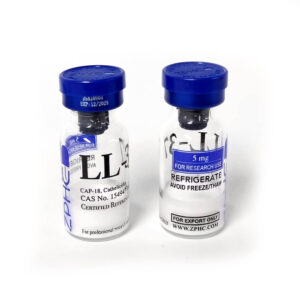
LL-37 ZPHC – 25mg KIT Overview
LL-37 is a naturally occurring human cathelicidin peptide that has attracted substantial scientific interest because of its role in innate immune biology, antimicrobial activity, cellular signaling, and tissue-related research. The LL-37 ZPHC – 25mg KIT (5 × 5 mg) designation describes a research peptide configuration containing five individual 5 mg units, for a stated total of 25 mg.
For researchers evaluating LL-37, understanding the identity, presentation, intended research context, and limitations of available evidence is essential. LL-37 is not simply a conventional nutritional ingredient or an ordinary consumer supplement. It is a biologically active peptide that continues to be investigated across multiple areas of laboratory science.
The FDA identifies cathelicidin LL-37 in its discussion of bulk substances that may present significant safety concerns. The agency states that it does not have sufficient safety-related information to determine whether LL-37 would cause harm when administered to humans and identifies concerns involving peptide impurities, characterization, immunogenicity, and findings from nonclinical research.
Consequently, this product description should be understood as research-oriented information rather than medical guidance, treatment advice, or a recommendation for human administration.
What Is LL-37?
LL-37 is a 37-amino-acid peptide associated with the human cathelicidin antimicrobial peptide family. Scientific research has examined LL-37 in connection with innate host-defense mechanisms, cellular communication, inflammatory signaling, and interactions occurring at biological membranes.
Because LL-37 is biologically active, laboratory researchers study it in carefully controlled experimental environments. Research involving LL-37 can examine mechanisms such as peptide-membrane interactions, immune signaling, microbial interactions, cellular responses, and other molecular processes.
The FDA’s chemical-substance database identifies LL-37 as an ingredient substance, but inclusion in that database does not mean that a product containing the substance has received FDA approval.
25mg KIT Configuration
The listed configuration is:
- Product: LL-37 ZPHC
- Total quantity: 25 mg
- Configuration: 5 × 5 mg
- Peptide: LL-37
- Presentation: Five individual 5 mg units
- Research context: Laboratory and scientific investigation
A multi-unit format can be useful for research workflows where separate units are maintained for different experimental stages. Researchers should follow the validated procedures, handling requirements, and institutional protocols applicable to their specific research environment.
Product specifications should always be confirmed against the actual manufacturer’s documentation and current batch information rather than relying solely on third-party product descriptions.
LL-37 Research Areas
LL-37 has been investigated in several areas of biomedical research. These areas include innate immunity, antimicrobial peptide biology, inflammation, cellular signaling, epithelial biology, and tissue-response research.
Innate Immune Research
One major area of LL-37 research involves innate immunity. Researchers investigate how naturally occurring antimicrobial peptides participate in the body’s first-line biological defense mechanisms.
Antimicrobial Peptide Research
LL-37 is commonly studied as a host-defense peptide. Laboratory research examines its interactions with biological membranes and microorganisms to better understand antimicrobial peptide mechanisms.
Cellular Signaling
Scientific studies have also examined LL-37 in relation to cellular signaling pathways. These investigations can help researchers understand how peptide molecules influence cellular behavior under controlled experimental conditions.
Tissue and Barrier Research
Another area of investigation involves epithelial and barrier biology. LL-37 research can contribute to understanding interactions among peptides, cells, biological barriers, and local signaling environments.
These research areas should not be interpreted as established therapeutic indications. Laboratory findings do not automatically demonstrate that a peptide is safe or effective as a treatment in humans.
Quality and Product Verification
When evaluating an LL-37 research product, researchers should consider documentation such as batch identification, analytical testing, peptide identity, purity information, manufacturing documentation, storage requirements, and traceability.
Independent verification can be particularly important for peptide products because appearance alone cannot establish chemical identity, purity, concentration, sterility, or suitability for a particular experiment.
ZPHC’s official website states that zphc.com is the only official ZPHC website and provides dedicated routes for product inquiries and authenticity verification. It also warns users to be cautious about copied websites, unauthorized sellers, private payment instructions, and misleading authenticity claims.
Therefore, claims that a separate domain is an “official ZPHC website” should be independently verified through ZPHC’s own official channels before being relied upon.
Storage and Laboratory Handling
Peptide stability can depend on formulation, packaging, temperature, moisture, light exposure, and handling conditions. Researchers should therefore use the storage and handling instructions supplied with the specific batch rather than relying on generalized internet recommendations.
Before beginning an experiment, laboratory personnel should review the manufacturer’s documentation, institutional safety procedures, applicable laboratory protocols, and relevant regulatory requirements.
The correct handling procedure can vary according to the experimental design and the physical form of the material. Researchers should not assume that a research peptide is appropriate for injection, ingestion, topical application, or any other human use.
Research-Only Considerations
LL-37 should be approached as a research subject rather than as a consumer wellness product. The distinction is important because scientific investigation and approved medical use have different evidentiary and regulatory standards.
The FDA explains that approved medicines undergo evaluation of safety and effectiveness before approval for their intended uses. Drugs@FDA is the agency’s database for identifying FDA-approved human drug products.
The available FDA information concerning LL-37 raises important safety considerations rather than establishing it as an approved human therapy.
For that reason, responsible product information should avoid unsupported claims involving healing, immune enhancement, anti-aging, disease treatment, recovery, or guaranteed biological outcomes.
Why Accurate LL-37 Information Matters
Accurate documentation is one of the most valuable aspects of peptide research. A compelling product page should not rely on exaggerated promises. Instead, it should clearly identify the material, configuration, research context, verification resources, and limitations of the available evidence.
This approach provides researchers with useful information while avoiding claims that could incorrectly suggest clinical approval or established therapeutic benefits.
For organizations researching LL-37, product identity and traceability should remain central considerations. Batch documentation, analytical information, and official manufacturer verification can help researchers distinguish legitimate product information from unsupported third-party claims.
Final Summary
The LL-37 ZPHC – 25mg KIT (5 × 5 mg) is described as a five-unit research peptide configuration containing 5 mg per unit and 25 mg total. LL-37 is a human cathelicidin peptide that has been extensively investigated in scientific literature involving innate immunity, antimicrobial peptide biology, cellular signaling, and related areas of molecular research.
However, LL-37 should not be represented as an FDA-approved treatment or as a proven human therapeutic. FDA information specifically identifies unresolved safety considerations surrounding LL-37, making accurate labeling, responsible research practices, and appropriate verification especially important.
For authenticity information, ZPHC identifies zphc.com as its official website and recommends using its official verification and contact routes when evaluating product or seller claims.
Research disclaimer: This information is provided for scientific and educational purposes. It does not constitute medical advice, a treatment recommendation, or instructions for human administration. Researchers should follow applicable institutional, legal, regulatory, and laboratory-safety requirements.
Be the first to review “LL-37 ZPHC – 25mg KIT (5×5 mg)”
Related products
Anti-Aging
Reviews
There are no reviews yet.