

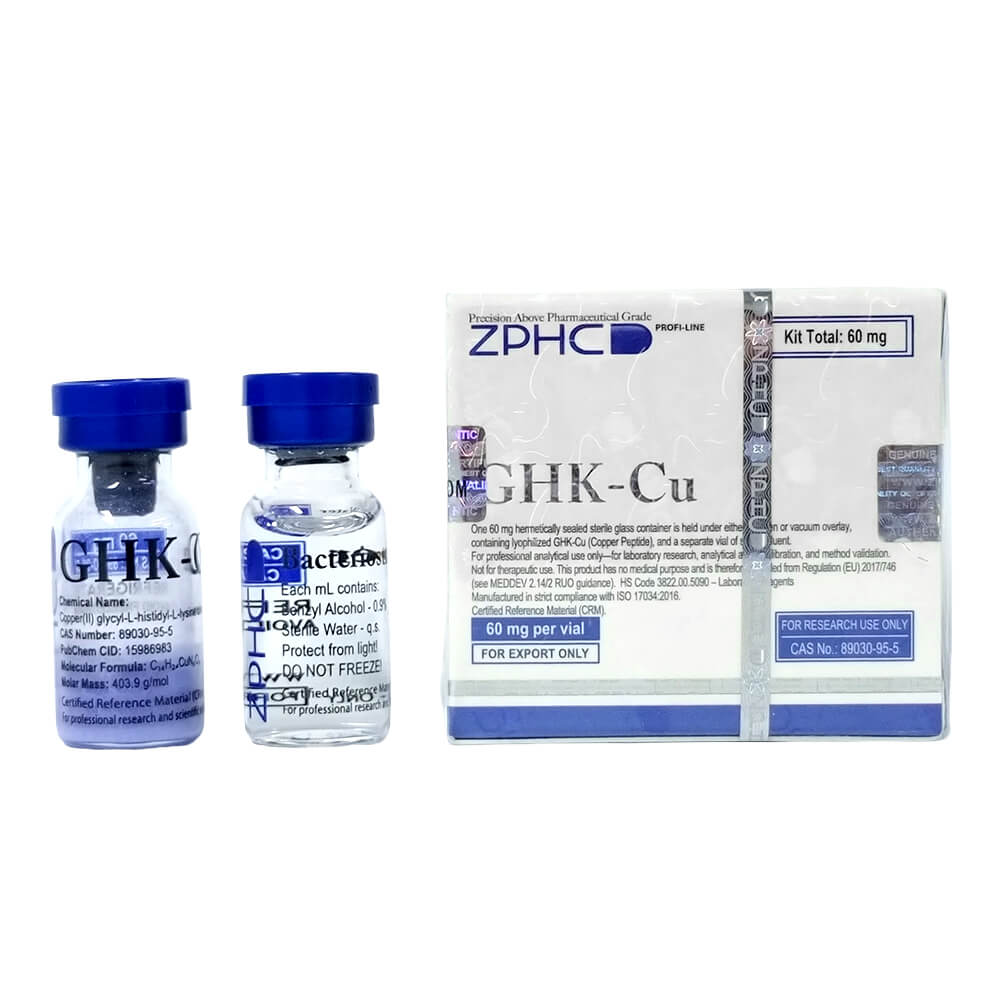
GHK-Cu 60mg Kit ZPHC – Lyophilized Peptide + Bacteriostatic Water
The GHK-Cu 60mg Kit ZPHC is a peptide-focused product consisting of lyophilized GHK-Cu and bacteriostatic water. GHK-Cu, also known as copper tripeptide or glycyl-L-histidyl-L-lysine copper complex, has attracted substantial scientific and cosmetic interest because of its interaction with copper and its potential role in skin and tissue biology.
For customers researching ZPHC GHK-Cu, understanding the product composition, scientific background, storage considerations, and limitations of current evidence is important. GHK-Cu has been studied for decades in laboratory and cosmetic contexts, but the strength of evidence differs substantially depending on the application and route of administration.
This product description is intended for informational and research-oriented purposes. It does not establish that this kit is approved for human administration, nor does it provide instructions for injection, reconstitution, dosing, or treatment.
What Is GHK-Cu?
GHK-Cu is a copper-binding tripeptide formed from glycyl-L-histidyl-L-lysine and copper. It is frequently discussed in cosmetic science, peptide research, regenerative biology, and skin research.
Preclinical research has investigated GHK-Cu in connection with biological processes involving tissue remodeling, antioxidant activity, inflammation, extracellular matrix components, and cellular signaling. Recent systematic reviews continue to describe significant scientific interest while emphasizing that human clinical evidence remains comparatively limited.
That distinction is important for anyone searching for ZPHC GHK-Cu 60mg. Laboratory findings can help researchers understand a compound’s biological potential, but promising laboratory observations should not automatically be interpreted as proven therapeutic effects in humans.
ZPHC GHK-Cu 60mg Kit Overview
The product is described as a kit containing:
- GHK-Cu 60mg in lyophilized form
- Bacteriostatic water
- Peptide-oriented kit configuration
- Copper tripeptide formulation intended for research-focused consideration
Lyophilization, commonly called freeze-drying, is widely used for peptide products because removing water can help create a more stable dry formulation during storage when appropriate conditions are maintained.
The inclusion of bacteriostatic water makes this product different from a standalone dry peptide vial. However, the presence of bacteriostatic water does not by itself establish that the resulting preparation is suitable, sterile, approved, or safe for administration to humans.
Why GHK-Cu Attracts Scientific Interest
One reason GHK-Cu remains a popular subject in peptide research is its relationship with copper biology. Copper participates in numerous physiological processes, while peptides can interact with cellular and extracellular systems in highly specific ways.
Researchers have examined GHK-related compounds in areas including:
- Skin biology
- Extracellular matrix research
- Collagen-related pathways
- Oxidative stress
- Inflammatory signaling
- Tissue-repair mechanisms
- Cosmetic formulation science
- Peptide delivery research
A 2026 systematic review described decades of preclinical evidence surrounding GHK-Cu while also noting that human clinical research remains relatively thin and fragmented.
This makes GHK-Cu 60mg ZPHC particularly relevant to people researching copper peptides, lyophilized peptides, peptide chemistry, and cosmetic-science applications.
GHK-Cu and Cosmetic Research
GHK-Cu is especially well known in skincare research. It has appeared in cosmetic formulations and has been investigated for potential effects related to the appearance and condition of skin.
However, the evidence should be interpreted carefully. A review of topical GHK and GHK-Cu literature found that although laboratory and cosmetic interest is substantial, published information concerning skin permeability, effectiveness, and physicochemical behavior remains insufficient for definitive conclusions.
An earlier controlled study involving copper tripeptide products after CO₂ laser resurfacing also illustrates why individual findings should not be generalized. The study did not find significant differences for several objective outcomes, although one questionnaire-based measure of overall skin quality showed a difference.
Consequently, GHK-Cu should be approached as an interesting research compound rather than as a guaranteed cosmetic or medical solution.
Lyophilized GHK-Cu Peptide
The lyophilized GHK-Cu format is a dry peptide presentation. Lyophilization is commonly used in laboratory and pharmaceutical research because removing water can support product stability under appropriate storage conditions.
Researchers evaluating a lyophilized peptide should pay attention to product documentation, labeling, lot information, storage requirements, testing documentation, and the manufacturer’s stated intended use.
Product quality can vary between suppliers. A product name or stated milligram amount alone does not establish purity, sterility, identity, potency, or suitability for a particular application.
For professional research environments, appropriate analytical documentation may include identity testing, purity testing, concentration information, and batch-specific quality records.
Bacteriostatic Water Component
The kit also includes bacteriostatic water. In general terminology, bacteriostatic water is water formulated with a preservative intended to inhibit bacterial growth under specified conditions.
Its presence in a kit should not be interpreted as evidence that the entire product is sterile or approved for human use. Researchers should rely on the manufacturer’s labeling and applicable laboratory protocols rather than assuming that a component’s characteristics automatically apply to the complete kit.
This distinction is particularly important for ZPHC peptide products, where the intended use and preparation requirements should be determined from the actual product documentation.
Research Considerations and Safety
There is an important reason to distinguish GHK-Cu research from injectable use.
The FDA’s current information identifies GHK-Cu for injectable routes of administration among substances that may present significant safety risks in compounded drugs. The agency specifically cites potential immunogenicity associated with aggregation and peptide-related impurities and notes that limited human data are available to inform safety considerations.
Therefore, this product should not be represented as an FDA-approved injectable medicine or as a clinically established treatment.
Anyone conducting legitimate laboratory research should follow institutional safety procedures, applicable regulations, product documentation, and qualified professional guidance. This description intentionally does not provide injection instructions, dosing recommendations, or directions for preparing the product for administration.
Product Quality Matters
When researching a GHK-Cu 60mg kit, quality documentation can be as important as the headline quantity.
Useful information to examine includes:
- Product identification
- Lot or batch number
- Stated peptide quantity
- Purity information
- Analytical testing
- Storage conditions
- Manufacturer documentation
- Intended-use statement
- Packaging information
- Expiration or retest information where applicable
A strong product listing should make it possible for a researcher to understand exactly what is being offered without relying on unsupported medical claims.
GHK-Cu Research Keywords
People researching this category may encounter terminology such as GHK-Cu peptide, copper peptide, GHK copper tripeptide, lyophilized GHK-Cu, GHK-Cu 60mg, ZPHC GHK-Cu, 60mg peptide kit, and bacteriostatic water kit.
These terms describe the product category and research interest; they should not be interpreted as evidence of a particular therapeutic outcome.
Frequently Asked Questions
What is GHK-Cu?
GHK-Cu is a copper-associated tripeptide consisting of glycyl-L-histidyl-L-lysine complexed with copper. It has been investigated extensively in laboratory and cosmetic research.
What does the ZPHC 60mg kit contain?
The product is described as containing 60mg of lyophilized GHK-Cu together with bacteriostatic water. Buyers should verify the exact contents and specifications against the product’s current labeling.
Is GHK-Cu FDA approved?
FDA status depends on the product, formulation, intended use, and route. GHK-Cu should not be described generally as an FDA-approved injectable treatment. FDA has specifically identified safety concerns regarding compounded injectable GHK-Cu.
Is GHK-Cu well studied?
GHK-Cu has a substantial preclinical research history, particularly in skin and tissue biology. However, recent reviews emphasize that human clinical evidence remains limited and that standardized clinical guidelines are lacking.
What is lyophilized peptide?
A lyophilized peptide is a peptide presented in a freeze-dried form. This format is commonly used in research and pharmaceutical development to support stability under specified storage conditions.
Final Product Summary
The GHK-Cu 60mg Kit ZPHC combines a lyophilized copper peptide with bacteriostatic water in a research-oriented kit format. GHK-Cu remains an intriguing and extensively investigated peptide in cosmetic science and laboratory research, particularly because of its relationship with copper biology, cellular signaling, tissue remodeling, and skin research.
Its scientific profile is promising but should be interpreted responsibly. Current literature supports continued investigation, while recent reviews emphasize the limitations of clinical evidence.
For researchers and informed readers comparing ZPHC GHK-Cu 60mg, the most important factors are transparent product specifications, quality documentation, intended use, appropriate storage, and an accurate understanding of what the existing evidence does—and does not—demonstrate.
Important: This product description is informational and research-oriented. It is not medical advice, does not establish therapeutic efficacy, and does not provide instructions for human administration.
Be the first to review “GHK-Cu 60mg Kit ZPHC (Lyophilized Peptide + Bacteriostatic Water)”
Related products
Injectable steroids
Injectable steroids
Anti-Aging
Injectable steroids
Injectable steroids
Injectable steroids
Testosterone Propionate ZPHC — 100 mg/ml (10 ampoules × 2 ml)
Injectable steroids
Injectable steroids
Reviews
There are no reviews yet.